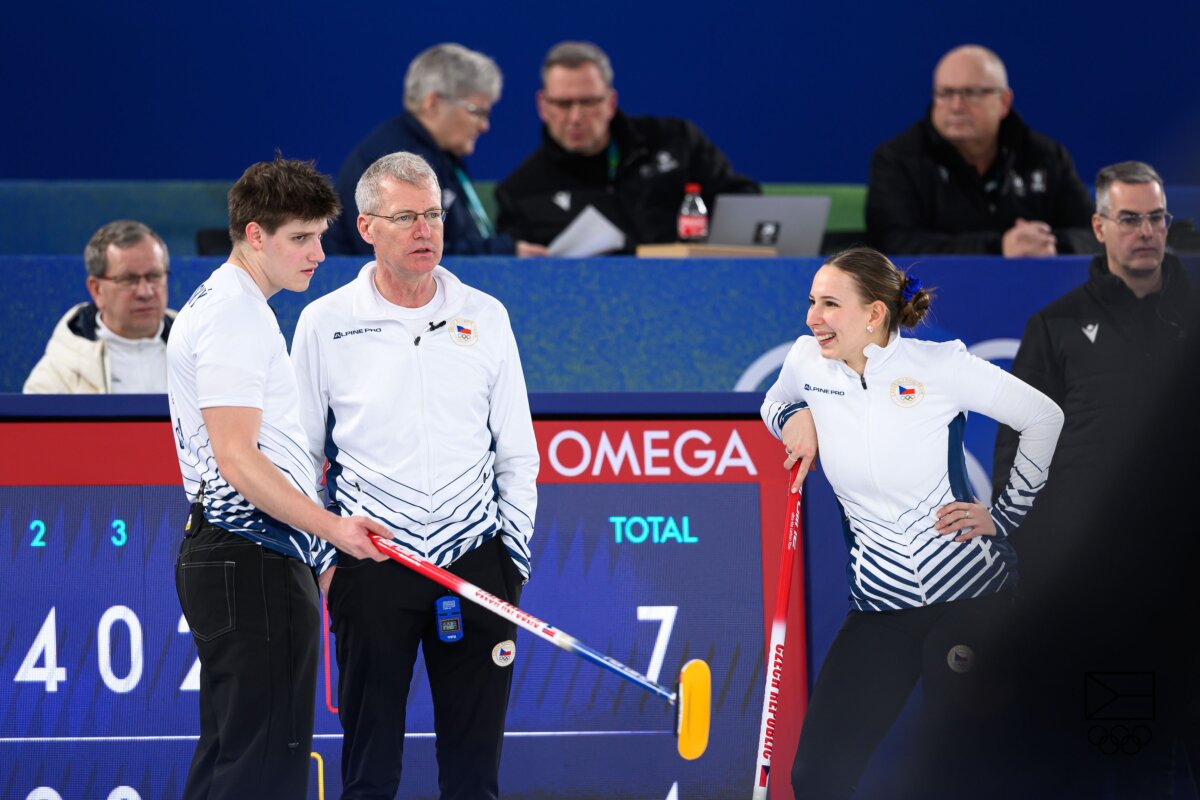
Coach Wade Scoffin’s engagement in the Czech Republic is coming to an end, but his enthusiasm and work with Czech curlers will stay with him for a long time. What does he take away from three years of cooperation, and what would he like to say to Czech curlers?
When you arrived in Prague and started working with Czech curling, what was it like? What surprised you?
I entered this role knowing that a lot of people had already done a tremendous amount of work before me and that many good things were already in place in Czech curling. From the very first day, I received a very warm welcome, and I considered it a privilege to work for Czech curling.
I approached the first year mainly as a period of learning and building relationships. My goal wasn’t to change everything from the ground up, but to build on what was already working, offer recommendations in areas that could benefit from modernization, and help fill any gaps in the system. Together with Pavel Myšák [then national team manager], we conducted a comprehensive analysis of how the federation operated during the first season and prepared a report with recommendations.
What was new to me was the importance of the club system in Czech curling and its influence across all levels of the sport—from the first contact with the ice all the way to elite curling.
What was your main goal during your time working with the Czech national teams?
When I started, the main expectation was to help Czech curling qualify for the 2026 Olympic Games. At the same time, I wanted to contribute to setting up a system for the national teams that would ensure that investments in athletes would have a long-term impact. It wasn’t just about one-off results, but about creating an environment that would function well into the future.
I also felt that the results of Czech juniors in previous years did not reflect the true potential Czech curling has. That’s why I saw significant room for development.
What were your feelings when the men’s team qualified for the Olympics? And then the mixed doubles team?
When the men’s team secured their spot at the Olympic Games, I was absolutely thrilled and incredibly proud of everyone. At the time, I happened to be driving Craig to the airport in Regina and then spending time with my sister and her family. Shortly afterward, I received a video from Brad Askew showing the team celebrating and dancing right in the arena. Dozens of congratulatory messages followed from friends and colleagues in the curling world.
With the men’s team, I saw my main role as supporting the system and process set up by coach Savill. I tried to help, provide feedback, and strengthen a framework that was already working well.
In the case of mixed doubles in Kelowna, I feel that the qualification journey really began at the previous World Championship in Fredericton. This was followed by intensive work with Julie, Vít, and Čenda during the autumn, which laid the foundation for the eventual success.
At the previous Olympic qualification event, I coached the Korean mixed doubles team, when Australia unexpectedly qualified. This time, the roles were reversed, and we were able to use the experience I gained back then to benefit the Czech team. Honestly, I consider this qualification to be my greatest coaching achievement so far.
What were the Olympic Games themselves like?
Both Czech teams entered the Olympic tournament as the tenth seeds, so we approached it with the mindset that we had nothing to lose. Every win was a success. In the end, both teams recorded three victories and finished in eighth place overall, which is a result they can rightfully be proud of.
Personally, I tried not to take anything for granted. I took care of my health and recovery, but at the same time, I wanted to fully experience those unique moments and create memories for a lifetime. I also tried to enjoy the entire experience as much as possible and spread positive energy. Meeting coaches and colleagues from all over the world was very valuable to me. I also made an effort to be a good representative of Czech curling and of the Czech Republic.
One of the most powerful personal moments for me was meeting one of my former Korean athletes. After the disappointment of an unsuccessful qualification four years ago, we were able to meet again—this time directly at the Olympic Games—and share the joy of finally both being there.
What needs to be done for Czech curling to break into the world’s elite?
That’s a simple question, but a very complex answer.
Reaching the absolute world elite is a beautiful and ambitious vision, but first it’s necessary to focus on smaller, gradual goals. I consider the modernization of long-term athlete development in Czech curling to be crucial. At the same time, I believe that the current model—where national team status is granted to a club team based on the result of the Czech championship—no longer reflects modern trends in high-performance sport.
If the goal is truly to place Czech curling among the world’s best nations, it will be necessary to look for new approaches and systemic solutions. It’s a long journey, but definitely an achievable one.
Do you have a message for Czech curlers?
Above all, I would like to say just one thing: thank you.
It has been a great honor for me to be part of the Czech curling community over the past three years. The passion I encountered among Czech curlers is comparable to that in the biggest curling nations in the world. The greatest reward for me is the new friendships and professional relationships I have built thanks to this experience.
Special thanks go to Marek Vydra and David Šik, who played a key role in giving me this opportunity in the first place.
And even though my time in this role is coming to an end, I believe I will continue to meet and work with many of you. After all, the curling world is much smaller than it might seem at first.